
- What Is Uzbek Plov?
- Tips for Cooking and Prepping
- Recipe Variations and Substitutes
- Serving Suggestions
- Storing, Make-Ahead, and Freezing Tips
- FAQs
- Uzbek Plov Recipe: Master This Classic Lamb Dish Today
If you’ve never had real Uzbek plov, you’re in for a treat: tender lamb, sweet carrots, and fragrant basmati rice all simmered together until every grain is perfumed with garlic, cumin, and coriander. This one-pot wonder looks impressive but comes together with simple techniques you can absolutely master at home, even on your first try.
What Is Uzbek Plov?
Plov (also spelled palov or pilaf) is the national dish of Uzbekistan, a beloved rice pilaf built on layers of lamb, onions, carrots, and whole spices cooked together in rendered fat. Every region and even every family has their own version, but the classic Uzbek approach relies on a rich broth called zirvak, made from browned lamb, sweated onions and carrots, and a whole head of garlic that simmers right in the pot, that gets absorbed by the rice as it steams.
What sets true Uzbek plov apart from other pilafs is the way the rice is cooked entirely by absorption and steam rather than being boiled and drained. The rice sits directly on top of the meat and carrots, soaking up the flavorful stock as it cooks, then finishes steaming under a towel-wrapped lid so every grain stays separate and fluffy. Tart dried barberries add a bright, tangy contrast to the richness of the lamb fat, making this dish a true balance of savory, sweet, and sour flavors in every bite.
Tips for Cooking and Prepping
#1: Rinse the rice until the water runs clear
Basmati rice carries a lot of surface starch, and rinsing it thoroughly prevents the plov from turning gluey instead of fluffy and separate.
#2: Don’t skip toasting your whole spices
Lightly toasting the peppercorns, coriander, and cumin before grinding wakes up their essential oils and gives the zirvak a much deeper, more aromatic base.
#3: Keep the garlic bulb whole
The whole head of garlic simmers gently in the broth, mellowing into a soft, sweet flavor that infuses the whole pot without overpowering it, then gets served as a rustic garnish.
#4: Never stir once the rice goes in
Layer the rinsed rice on top of the meat and carrots without mixing it in; stirring at this stage disrupts the layering that lets the rice steam properly and stay fluffy.
#5: Poke steam channels before the final rest
Using a chopstick to create a few holes down to the bottom of the pot lets trapped steam escape and finish cooking the rice evenly during the final rest.
#6: Give it a real rest under a towel
Wrapping the covered pot in a thick towel for the last 20 minutes traps steam and heat, which is essential for fully cooking the rice and letting the flavors meld.
Recipe Variations and Substitutes
While lamb shoulder or stew meat is traditional, goat meat is a common and delicious substitute if you can find it, and beef chuck can work in a pinch for a milder flavor. If dried barberries aren’t available at your local market or online, chopped dried cranberries or even pomegranate arils can stand in for that same tart, fruity contrast. Some cooks also like to add a few whole dried chili peppers or a handful of raisins nestled into the rice for extra depth.
Serving Suggestions
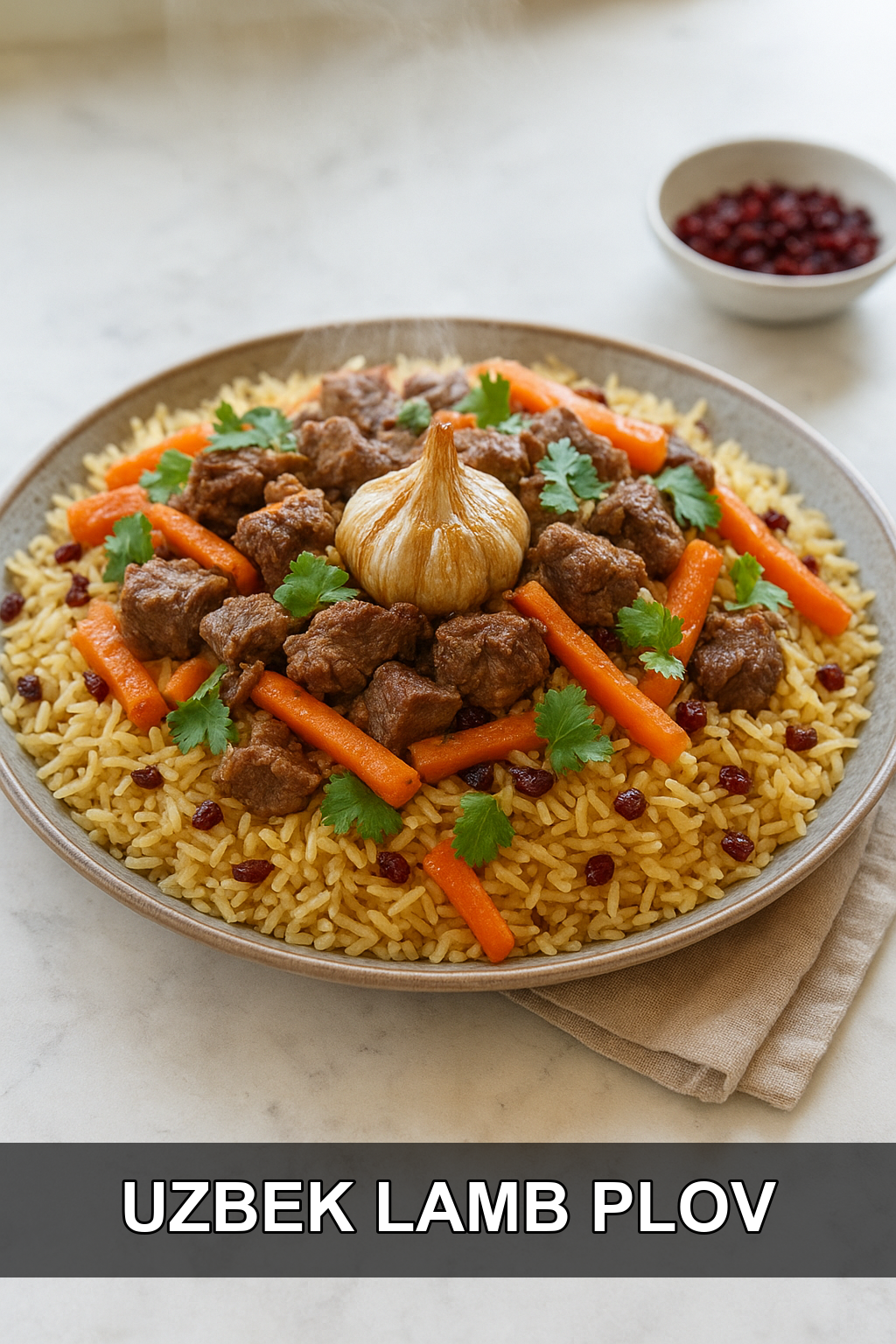
Plov is traditionally served family-style on a large communal platter, with the fluffy rice mounded first and the lamb, carrots, and whole garlic bulb piled on top. A scattering of fresh cilantro adds color and freshness, and it’s often accompanied by a simple shredded cabbage and tomato salad or Achichuk (an Uzbek tomato-onion salad) to cut through the richness, along with warm flatbread and hot tea.
Storing, Make-Ahead, and Freezing Tips
Leftover plov keeps well in an airtight container in the refrigerator for up to 4 days; reheat gently in a covered skillet with a splash of water or stock to revive the rice’s texture. You can also freeze portions for up to 2 months, though the rice texture is best enjoyed fresh, so thaw overnight in the fridge and reheat low and slow rather than microwaving on high.
FAQs
What kind of rice works best for plov?
Basmati rice is essential because its long, sturdy grains hold their shape and stay separate during the steaming process. Short or medium grain rice tends to turn mushy and won’t replicate the classic fluffy texture.
Can I make Uzbek plov without lamb fat?
Yes, you can substitute a neutral cooking oil for the lamb fat if you prefer, though the fat does add a distinct richness that’s traditional to the dish. Just make sure you’re using enough fat to properly brown the meat and sweat the onions.
Why is my plov rice mushy or undercooked?
This usually comes down to rinsing the rice insufficiently, too much or too little liquid, or skipping the final steam-and-rest step. Make sure the rice is just barely covered with liquid before covering and always let it rest wrapped in a towel at the end.
Where can I find dried barberries?
Dried barberries are commonly sold at Middle Eastern, Persian, or specialty spice shops, as well as online. If you can’t track them down, chopped dried cranberries or pomegranate seeds make a good substitute for that same tart brightness.
Can I make plov in advance for a party?
Plov can be made a day ahead and gently reheated, covered, on the stovetop with a splash of stock or water to restore moisture. Many cooks actually feel the flavors deepen and improve slightly after resting overnight.
Uzbek Plov Recipe: Master This Classic Lamb Dish Today
Prep time: 25 min | Cook time: 90 min | Total time: 115 min | Servings: 8
Ingredients
For the Lamb and Zirvak
- 1.5 lbs lamb shoulder or stew meat (or substitute goat)
- 1 tablespoon salt
- 1 head of garlic
- 1 teaspoon black peppercorns
- 1 tablespoon coriander seed
- 1.5 tablespoon cumin seed
- 1/3 cup dried barberries (plus more to taste, optional; chopped dried cranberries or pomegranate seeds can be substituted)
- 10 oz (1 large) yellow onion, cut into medium dice
- 15 oz (4-6 medium) carrots, peeled and cut into 2-inch batons to yield 12 oz
- 1/2 cup lamb fat
- 3 cups lamb stock (or 3 cups water)
For the Rice
- 1.5 cups basmati rice (do not use long grain rice or it may not cook properly)
For Garnish
- Fresh cilantro, to garnish, optional
Instructions
- Rub the garlic bulb with your hands to remove as much of the outer paper as possible. Toast the peppercorns, coriander, and cumin lightly in a dry pan, then grind and reserve.
- Cut the lamb into bite-sized pieces and season with 1 tablespoon of the salt.
- Meanwhile, in a Dutch oven, heat the lamb fat (or oil) until lightly smoking; it will seem like a lot of fat, but that’s normal.
- Brown the lamb in the fat, then remove and reserve. Add the onion to the same fat, stir for a few minutes, and cook until translucent.
- Add the stock, garlic bulb, barberries, and ground spices back into the pot along with the lamb. Cover and cook at a gentle simmer for 30 minutes.
- Meanwhile, rinse the rice in water until it runs clear.
- Sweat the carrots on medium-high heat in a separate pan for 5 minutes, then add them to the pot at the 30-minute mark. Simmer gently, covered, for another 30 minutes.
- Push the lamb and carrots down under the liquid to give the rice somewhere to sit.
- Drain the rice well, then spread it evenly on top of the lamb-carrot mixture, being careful not to stir it in.
- Press down gently on the rice to make sure it’s just barely covered by the liquid. If the liquid has cooked down too far, add just enough water so the rice is barely covered.
- Cover the pot and cook for another 20 minutes at a very gentle simmer.
- Remove the lid and, using a spoon, carefully mound the rice into a dome shape so it isn’t touching the sides of the pot.
- Using a chopstick or the handle of a thin wooden spoon, poke a few holes down to the bottom of the pot to create steam channels.
- Remove the pot to a trivet, wrap it tightly in a thick towel, and let the plov rest and steam for a final 20 minutes.
- To serve, remove the lid and towel. Spoon the rice out first onto a platter, then mound the meat and carrots on top. Garnish with fresh cilantro and the whole garlic bulb, and serve immediately.
For extra tang, add more barberries just before serving as a garnish. If you don’t have lamb stock on hand, water works fine since the zirvak develops plenty of flavor on its own.
Leave a Reply
You must be logged in to post a comment.