
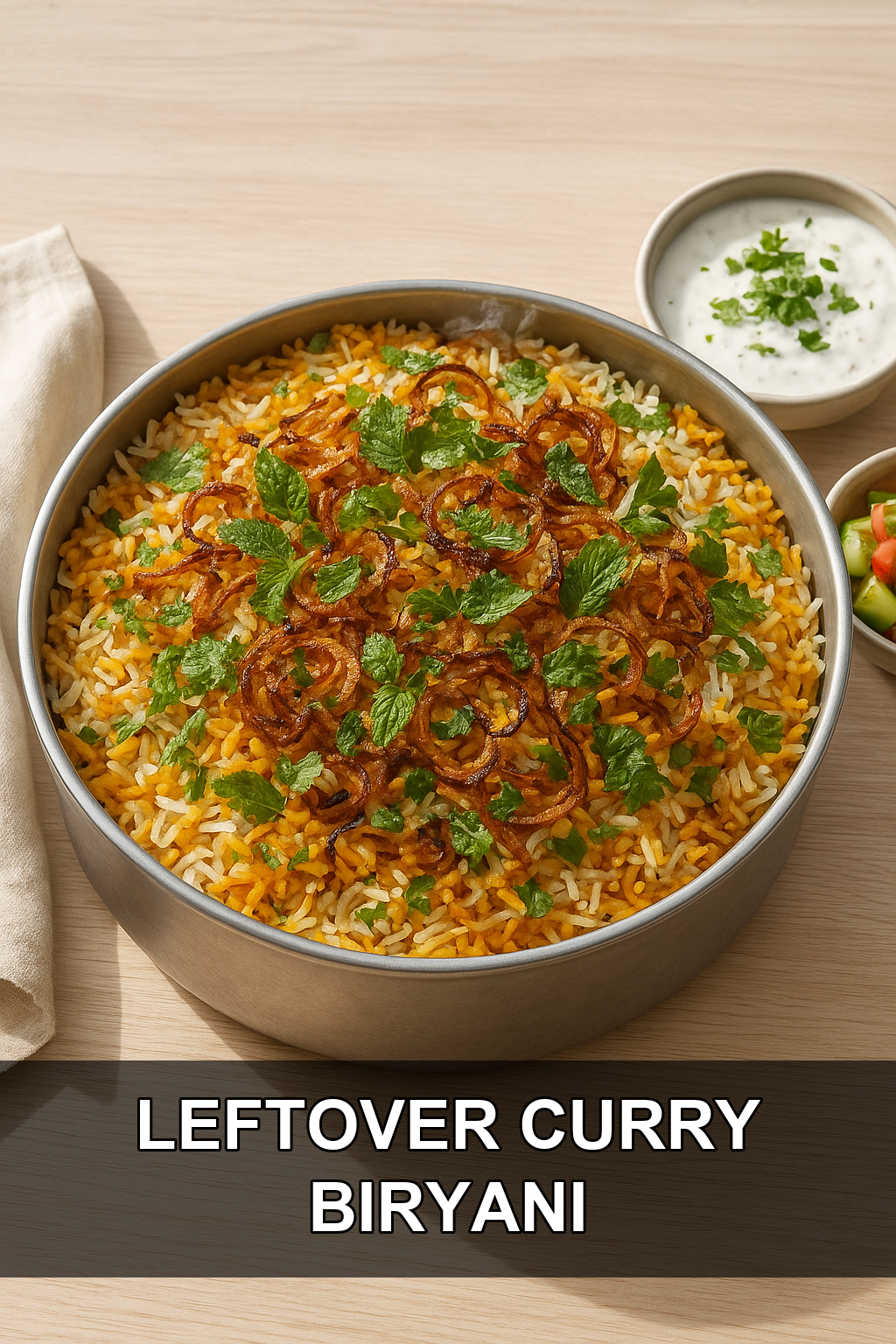
- What Is Leftover Biryani Rice?
- Tips for Cooking and Prepping
- Recipe Variations and Substitutes
- Serving Suggestions
- Storing, Make-Ahead, and Freezing Tips
- FAQs
- Leftover Biryani Rice Recipe
Got leftover curry sitting in the fridge and a busy weeknight ahead? This layered biryani rice dish is the answer you didn’t know you needed. It transforms yesterday’s dinner into something that looks and tastes like it took hours, when really it’s just clever layering and a little patience while it steams.
What Is Leftover Biryani Rice?
Leftover biryani rice isn’t a shortcut version of biryani so much as a smart, practical way of making the real thing. Instead of cooking a curry specifically for the biryani, you use whatever curry you already have on hand, whether that’s a chicken curry, a lentil dal, or a vegetable masala, and layer it with fragrant, part-cooked basmati rice. The rice is spiced with whole cumin, cardamom, cinnamon, and bay leaf, then finished with fried onions, fresh herbs, a touch of food colour, and fragrant kewara water before everything steams together.
This method, often called ‘dum’ cooking, is the traditional technique behind classic biryani: the rice and curry never fully mix while cooking, but instead steam together under a tight lid so the flavours meld while each layer keeps its own texture. It’s a brilliant way to breathe new life into leftovers and turn a fridge clean-out into a proper, celebratory meal.
Tips for Cooking and Prepping
#1: Soak the rice properly
Don’t skip the 30-minute soak. It helps the basmati grains cook evenly and stay long and fluffy rather than breaking apart during the second steaming stage.
#2: Stop the rice at 80% cooked
The rice will finish cooking during the steaming (dum) step, so pull it off the boil while it still has a slight bite. Fully cooked rice at this stage will turn mushy by the time you serve it.
#3: Fry the onions until deeply golden
Golden brown, crispy onions add a sweet, savoury crunch that’s essential to real biryani flavour, so don’t rush this step or pull them too early.
#4: Get your lid seal tight
A firm-fitting lid is key to trapping steam during the final 15-20 minutes; if your lid isn’t tight, wrap the pot rim with foil or a damp cloth before covering.
#5: Don’t stir the layers before steaming
Resist mixing the curry and rice together before the dum step. The layering is what gives biryani its distinct pockets of flavour and colour once it’s gently folded together at serving time.
#6: Use a thick, leftover curry
Curries with a bit of gravy but not too much liquid work best here, since excess liquid can make the bottom rice layer soggy instead of fluffy.
Recipe Variations and Substitutes
This recipe is endlessly adaptable depending on what leftovers you have. Swap in leftover chicken curry, lamb curry, a vegetable korma, or even a simple dal for the curry layer, and adjust the whole spices to suit your taste, using a little less cinnamon or cardamom if you prefer a milder aroma. If you don’t have kewara (screwpine) water, a splash of rose water works as a substitute, or you can leave it out entirely for a more subtle version.
Serving Suggestions
Biryani is best served hot, straight from the pot, with a cooling side of raita to balance the warm spices. A simple cucumber and tomato salad, some crispy papad, or a wedge of lemon on the side round out the meal nicely for a satisfying weeknight dinner.
Storing, Make-Ahead, and Freezing Tips
Leftover biryani keeps well in an airtight container in the fridge for up to 3-4 days, and it also freezes beautifully for up to 2 months, making it worth doubling the batch. Reheat gently with a splash of water on the stovetop or in the microwave, covered, so the rice doesn’t dry out.
FAQs
Can I use plain leftover rice instead of freshly par-boiled biryani rice?
You can, but the texture won’t be quite the same since fully cooked leftover rice tends to go soft or clumpy during the steaming step. For the best fluffy, layered result, it’s worth par-cooking fresh rice as instructed.
What kind of leftover curry works best for this biryani?
A thicker curry with some gravy but not too much liquid works best, such as a leftover chicken curry, mutton curry, or a vegetable masala. Very watery curries can make the bottom layer of rice soggy.
Do I have to use food colour and kewara water?
No, both are traditional but optional additions. The food colour just adds visual contrast between the rice layers, and the kewara water adds a subtle floral aroma, so you can skip either if you prefer a simpler version.
How do I know when the rice is 80% cooked?
The grains should be soft on the outside but still firm and slightly undercooked in the very center when you bite into one. It will finish cooking fully during the final steaming step.
Can I make this biryani vegetarian?
Absolutely, simply use a leftover vegetable curry, chana masala, or dal in place of a meat curry, and follow the same layering and steaming method.
Leftover Biryani Rice Recipe
Prep time: 40 min | Cook time: 40 min | Total time: 80 min | Servings: 5
Ingredients
For the Rice
- 2 cups white basmati rice
- 1.5 tsp cumin seeds
- 6 green cardamom pods
- 2 black cardamom pods
- 2 bay leaves
- 1 large stick cinnamon
- 2.5 tsp salt (or to taste)
- 1 tsp oil
For the Layers and Garnish
- 1 handful fresh coriander, chopped
- 1 handful fresh mint, chopped
- other garnishing of choice (see notes)
- 0.5 tsp orange/yellow food colour
- 1 tbsp kewara water
- 2 medium onions, sliced
- oil, for deep frying the onions
- leftover curry (see notes)
Instructions
- Soak the basmati rice in water for at least 30 minutes, then drain it well.
- Add the drained rice to a large pot along with the cumin seeds, green cardamom, black cardamom, bay leaves, cinnamon stick, salt, and 1 tsp oil. Cover with plenty of water and bring to a boil over high heat, cooking until the rice is about 80% cooked. Drain in a colander.
- While the rice cooks, heat a good amount of oil in a pan and fry the sliced onions on high heat until golden brown and crispy. Set aside for garnishing.
- In a heavy-bottomed pot, begin layering: add half of the leftover curry, followed by half of the part-cooked rice, then scatter over half of the fried onions, chopped coriander, mint, and any other garnishes, plus a drizzle of food colour and kewara water.
- Repeat with a second layer using the remaining curry, rice, and garnishing ingredients.
- Turn the heat to the lowest setting, cover the pot tightly with a firm-fitting lid, and let it steam for 15-20 minutes without lifting the lid.
- Gently fluff and fold the layers together before serving hot, with raita and a simple salad on the side.
For ‘other garnishing,’ fried nuts, raisins, or thin lemon slices are traditional additions layered in alongside the herbs and onions. Use whatever thick leftover curry you have on hand, chicken, mutton, or vegetable, as the flavour base for this dish.
Leave a Reply
You must be logged in to post a comment.