
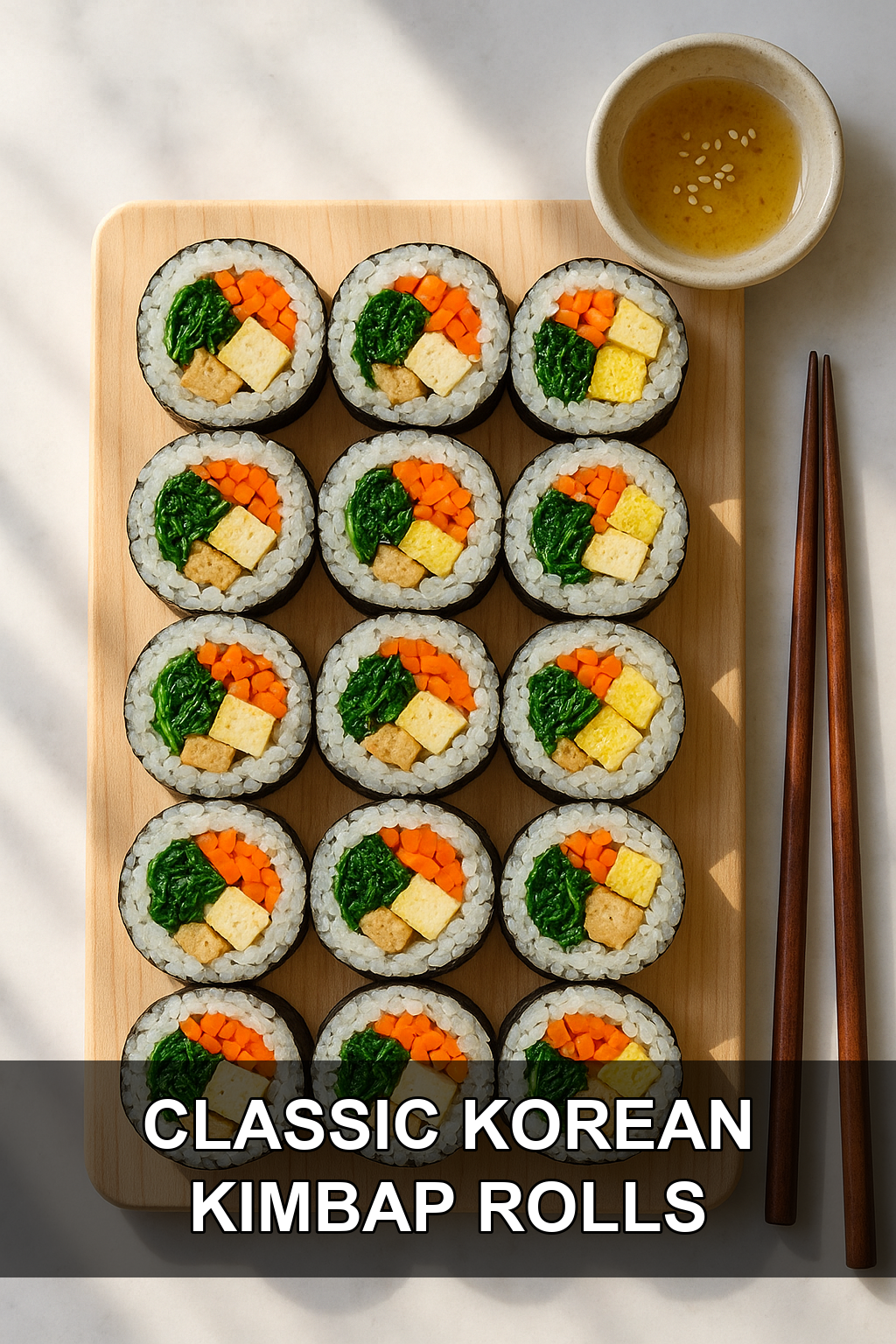
- What Is Kimbap?
- Tips for Cooking and Prepping
- Recipe Variations and Substitutes
- Serving Suggestions
- Storing and Make-Ahead Tips
- FAQs
- Kimbap Recipe: A Fun and Flavorful Korean Dish
If you’ve ever eyed those beautiful rainbow-striped rolls at a Korean market and wondered how they’re made, today’s your lucky day. This kimbap recipe walks you through building your own seaweed rice rolls from scratch, packed with seasoned spinach, sweet carrots, savory tofu, and a fluffy egg omelet — no sushi rice or raw fish required.
What Is Kimbap?
Kimbap (also spelled gimbap) is a beloved Korean staple made of seasoned rice and an assortment of vegetables, proteins, and eggs rolled tightly in sheets of roasted seaweed, then sliced into bite-sized rounds. It’s often compared to sushi because of its appearance, but the flavors and ingredients are distinctly Korean — the rice is seasoned with sesame oil instead of vinegar, and the fillings lean toward sautéed vegetables, pickled radish, and marinated proteins rather than raw fish.
Tips for Cooking and Prepping
#1: Season your rice while it’s warm
Stirring the sesame oil, salt, and pepper into the rice right after cooking helps the seasoning distribute evenly and keeps the grains glossy and fragrant instead of clumpy.
#2: Squeeze the spinach dry
After blanching, really wring out the spinach with your hands — excess water is the number one culprit behind soggy, hard-to-slice kimbap.
#3: Don’t overfill your rolls
It’s tempting to pile on extra veggies, but too much filling makes the roll difficult to close and prone to splitting when sliced. Stick to thin, even rows of each ingredient.
#4: Leave a border of bare seaweed
Spreading rice over only about 80% of the sheet, leaving the top edge bare, gives you room to seal the roll shut without rice squeezing out the sides.
#5: Oil your knife before slicing
A light brush of sesame oil on both the roll and your knife blade prevents sticking and gives you clean, neat slices instead of a smeared, torn edge.
#6: Prep components ahead of time
Kimbap has several small components (rice, egg, spinach, carrots), so cooking each one in advance and laying them out assembly-line style makes rolling much faster and less stressful.
Recipe Variations and Substitutes
Kimbap is endlessly customizable once you’ve mastered the basic roll. Swap in thin strips of Korean-style plant-based steak with sautéed sweet potato vermicelli for a heartier bite, or marinate tofu cutlets in beet juice for a vibrant pink filling that adds color without any artificial dye. You can also layer in pickled burdock root, purple cabbage, or perilla leaves for extra crunch and flavor, and for a showstopping presentation, try shaping tofu or egg into a heart-shaped center so every slice reveals a fun design. Not vegan? Swap the liquid egg replacer for real eggs and use a traditional egg omelet (gyeranmari) instead.
Serving Suggestions
Serve kimbap slices on a platter with extra sesame oil for dipping, or alongside a bowl of kimchi and a light miso or seaweed soup for a more complete meal. It also makes a fantastic picnic or lunchbox food since it’s meant to be eaten at room temperature, and pairs nicely with pickled radish or a simple cucumber salad on the side.
Storing and Make-Ahead Tips
Kimbap tastes best the day it’s made since the rice can firm up and the seaweed can soften once refrigerated, but you can prep all the individual fillings — rice, spinach, egg, carrots, tofu — up to two days ahead and store them separately in airtight containers. When you’re ready to eat, roll and slice just before serving; if you do need to store finished rolls, wrap them tightly in plastic and refrigerate for up to a day, then let them sit at room temperature for 15-20 minutes before slicing and eating.
FAQs
Is kimbap the same as sushi?
No — while they look similar, kimbap uses rice seasoned with sesame oil instead of vinegar, and the fillings are typically cooked or pickled vegetables, egg, and proteins rather than raw fish.
Can I make kimbap vegan?
Yes, this recipe is already vegan-friendly using a liquid egg replacer or JUST Egg in place of real eggs and baked tofu instead of meat, so you can enjoy all the classic flavors without any animal products.
Why does my kimbap fall apart when I slice it?
This usually happens if the roll wasn’t packed tightly enough, the rice layer was too thin or uneven, or the fillings weren’t drained properly, so be sure to squeeze out excess moisture and roll firmly with the bamboo mat.
What kind of rice should I use for kimbap?
Short grain white rice works best because its natural stickiness helps the roll hold together, unlike long grain rice which tends to be too loose and dry.
Is it spelled kimbap or gimbap?
Both spellings refer to the same dish; ‘gimbap’ is the more accurate romanization of the Korean word, while ‘kimbap’ is the more commonly used spelling in English.
Kimbap Recipe: A Fun and Flavorful Korean Dish
Prep time: 90 min | Cook time: 30 min | Total time: 120 min | Servings: 12
Ingredients
For the Rice
- 2 1/2 cups cooked short grain white rice
- 1 1/2 tbsp sesame oil, plus more for garnish
- 2 tsp sea salt, divided
- 2 tsp black pepper, divided
For the Spinach
- 1 lb adult spinach
For the Gyerranmari (Korean Egg Omelet)
- 1 tbsp extra virgin olive oil
- 1/2 cup liquid egg replacer (or 1 JUST Egg Folded)
For the Carrots
- 1 1/2 cups julienned carrot
For Assembly
- 4 sheets roasted seaweed
- 1 (7 oz) baked tofu cutlet, cut into batons
- 4 spears yellow or white pickled daikon radish
- 8 spears pickled burdock root
Instructions
- Make your base rice by stirring together the cooked rice, 1 teaspoon of sesame oil, 1/2 teaspoon of salt, and 1/2 teaspoon of cracked black pepper. Set aside.
- Prepare the spinach by adding it to a large pot of boiling water. Cook until the leaves turn bright green, about 1 minute, then remove from heat, drain, and rinse with cold water. Squeeze out as much excess water as possible. In a small bowl, mix the spinach with 1/2 tablespoon sesame oil, 1/2 teaspoon salt, and 1/2 teaspoon black pepper. Set aside.
- Prepare the gyerranmari (Korean omelet) by heating 1/2 tablespoon of extra virgin olive oil in a medium non-stick pan over medium heat. Pour in the liquid egg replacer, sprinkle with a little salt and pepper, and cook for about 3 minutes, until a spatula easily loosens the egg from the pan. Flip like a crepe and cook another 2 minutes until both sides are set. Remove from heat, let cool, then cut into 1/2-inch wide strips.
- Prepare the carrots by heating 1/2 tablespoon of olive oil in a large sauté pan over medium-high heat. Once shimmering, add the carrots and sauté about 2 minutes until they begin to soften. Season with salt and pepper and finish with 1/2 tablespoon sesame oil before removing from heat. Set aside.
- To assemble, place a bamboo mat on a flat surface and lay a seaweed sheet, shiny side down, on top. Spread about 3/4 cup of the base rice evenly over roughly 80% of the sheet, starting from the bottom and leaving a 1 1/2-inch bare strip at the top. In the center of the riced area, layer 2 to 4 batons of tofu, 2 tablespoons of spinach, 2 tablespoons of carrot, 1 pickled daikon radish spear, 2 pickled burdock root spears, and 2 tablespoons of the sliced gyerranmari.
- Using the bamboo mat, start at the bottom and roll the sheet up and forward until the bottom edge meets the top of the riced area, tucking in any escaping fillings with your fingers. Gently squeeze the roll, pull the mat loose and forward, then squeeze and repeat until the entire sheet is rolled. Repeat with the remaining ingredients to make additional rolls.
- Brush each roll with a little sesame oil, slice into 1/2-inch thick pieces, and serve immediately.
For fun twists, try swapping in beet-marinated tofu for a pink filling, sautéed sweet potato vermicelli and plant-based steak for a heartier roll, or shaping fillings into a heart for a playful presentation.
Leave a Reply
You must be logged in to post a comment.