
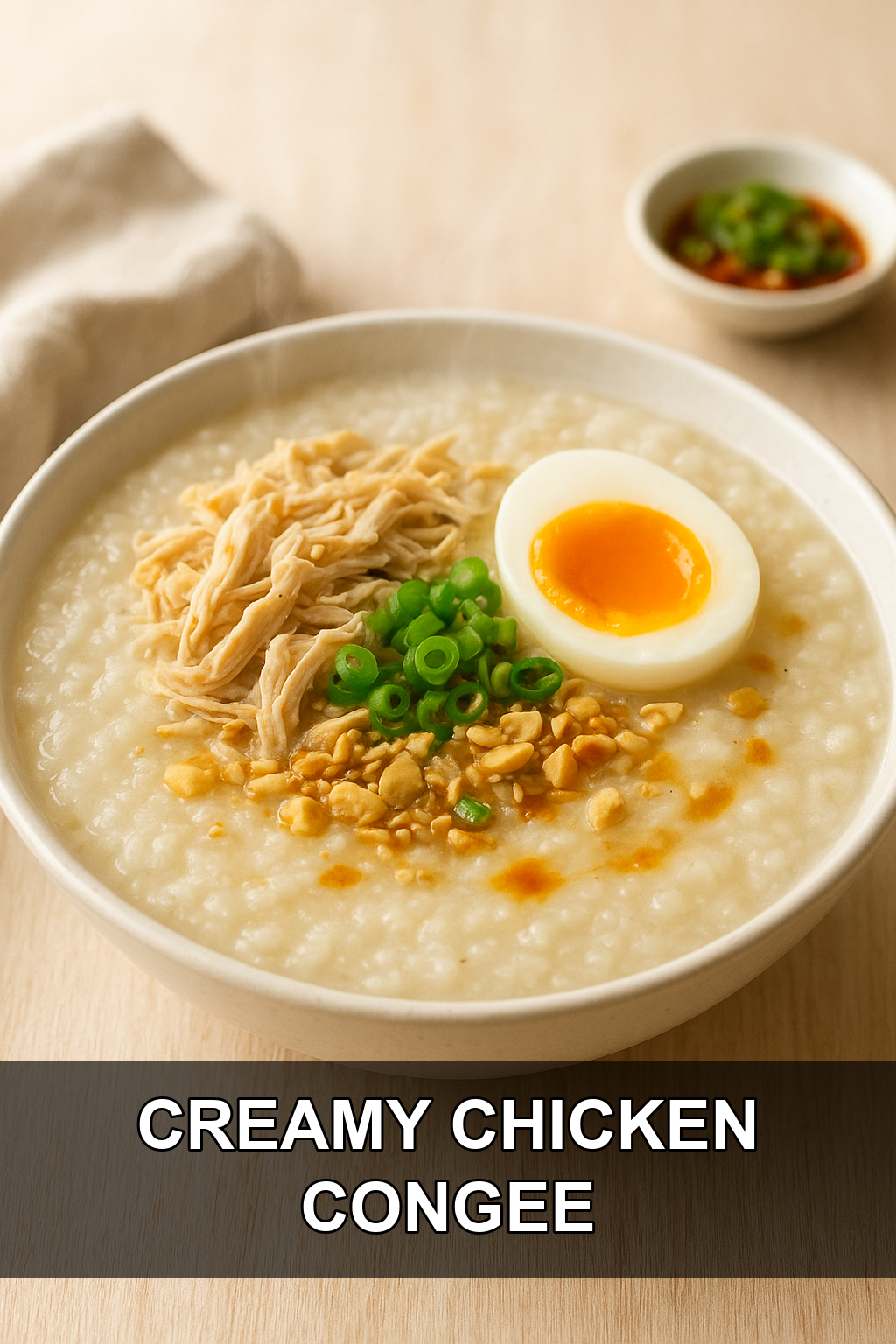
- What Is Chicken Congee?
- Tips for Cooking and Prepping
- Recipe Variations and Toppings
- Serving Suggestions
- Storing, Make-Ahead, and Freezing Tips
- FAQs
- Chicken Congee Recipe
There’s nothing quite as comforting as a warm bowl of congee, and once you know the basic ratio of rice to liquid, you can make it your own with shredded chicken, crunchy toppings, and whatever seasonings sound good that day. This recipe walks you through three simple methods for turning humble long-grain rice into silky, spoonable comfort food.
What Is Chicken Congee?
Congee is a savory rice porridge that’s eaten throughout China and much of Asia, often for breakfast or as a gentle, easy-to-digest meal when someone isn’t feeling well. Long-grain rice is simmered low and slow in a large amount of water or broth until the grains break down into a thick, creamy consistency somewhere between soup and porridge.
Chicken congee simply means the dish is built around chicken, whether that’s cooking the rice in chicken stock, stirring in shredded chicken at the end, or both. It’s a wonderfully flexible base recipe — the plain rice porridge is the canvas, and toppings like ginger, garlic, bok choy, soft-boiled eggs, and crushed peanuts are what turn it into a full, satisfying bowl.
Tips for Cooking and Prepping
#1: Soak the rice first
Soaking the rinsed rice for 30 minutes before cooking helps it break down faster and more evenly, giving you that classic smooth, creamy congee texture instead of separate grains floating in liquid.
#2: Use stock instead of water for extra flavor
Since this is chicken congee, swapping the plain water for chicken stock builds savory flavor right into the base, so you need less seasoning and topping later on.
#3: Tilt the lid while it simmers
Leaving the lid slightly tilted lets excess steam escape so the congee reduces and thickens properly, rather than staying watery or boiling over.
#4: Stir occasionally, not constantly
Congee doesn’t need babysitting, but a stir every 10-15 minutes prevents the rice from sticking or scorching on the bottom of the pot during the long simmer.
#5: Try the oil or freezer trick for faster results
Coating the soaked rice in a little oil before cooking helps it break down faster and gives a softer texture, while freezing soaked rice for a few hours before boiling can shortcut the cooking time even more.
Recipe Variations and Toppings
Congee is really a template more than a fixed recipe, so feel free to build your bowl however you like. Stir in minced ginger and garlic while the rice cooks for extra depth, or add lotus root and ginkgo nuts for a more traditional, slightly sweet undertone. For protein and texture, top individual bowls with shredded chicken, crumbled pork, a soft-boiled egg, wilted bok choy, or a sprinkle of crushed peanuts.
Serving Suggestions
Congee is traditionally served hot in individual bowls, often for breakfast, as a light lunch, or as a soothing meal when you’re feeling under the weather. Set out small bowls of toppings — chopped scallions, soy sauce, sesame oil, chili oil, crushed peanuts, and shredded chicken — so everyone can customize their own bowl at the table.
Storing, Make-Ahead, and Freezing Tips
Congee keeps well in the refrigerator for up to 4 days in an airtight container; it will thicken as it cools, so just stir in a splash of water or stock when reheating on the stove or in the microwave. It also freezes nicely for up to 2 months — thaw it in the fridge overnight and reheat gently, adding extra liquid to bring back its creamy consistency.
FAQs
What is the ratio of rice to water for congee?
A good starting ratio is about 1 part long-grain rice to 10-11 parts liquid, which in this recipe is 3/4 cup rice to 8 cups water or stock. You can adjust the liquid slightly depending on how thick or thin you like your congee.
Can I use leftover cooked chicken in congee?
Yes, shredded rotisserie chicken or leftover cooked chicken works great here — simply stir it in near the end of cooking so it warms through without drying out.
Why is my congee not thickening?
Congee needs a long, slow simmer for the rice starches to fully break down, so if it’s still thin, it likely just needs more time on low heat with the lid tilted to let steam escape. Soaking the rice beforehand and stirring occasionally also helps it thicken properly.
Can I make congee faster?
Yes — coating soaked rice with a little oil before cooking speeds things up and softens the texture, or you can freeze soaked rice for 2-3 hours before boiling, which breaks the grains down faster and cuts the cooking time to around 30 minutes total.
Is congee the same as rice porridge or jook?
Yes, congee, rice porridge, and jook (or juk) all refer to the same style of long-simmered rice dish, just with different names depending on the region or language.
Chicken Congee Recipe
Prep time: 5 min | Cook time: 105 min | Total time: 110 min | Servings: 6
Ingredients
For the Congee Base
- 3/4 cup long-grain rice
- 8 cups water (or chicken, vegetable, or beef stock)
- 1 teaspoon salt (Method 1) OR 1 teaspoon sunflower, peanut, vegetable, or olive oil (Method 2)
Optional Toppings & Add-Ins
- Minced ginger
- Minced garlic
- Lotus root
- Gingko nuts
- Shredded chicken
- Shredded or crumbled pork
- Bok choy
- Soft-boiled egg
- Crushed peanuts
Instructions
- Gather all of your ingredients before you begin, including any optional toppings you plan to use.
- Method 1 (Classic Simmer): Rinse and wash 3/4 cup long-grain rice, then soak it in water for 30 minutes and drain.
- In a large pot or Dutch oven, bring the soaked rice and 8 cups of water or stock to a boil.
- Once boiling, reduce the heat to medium-low. Cover with the lid tilted slightly to let steam escape, just as you would when cooking plain white rice.
- Cook on medium-low to low heat, stirring occasionally, until the rice breaks down into a thick, creamy porridge texture — this takes about 1 1/2 to 1 3/4 hours.
- Stir in 1 teaspoon salt, taste, and adjust seasoning. Add any toppings you like, such as shredded chicken and crushed peanuts, then serve.
- Method 2 (Oil Method, for a faster, smoother congee): Rinse and wash another 3/4 cup long-grain rice and soak it in water for 30 minutes, then drain.
- Toss the drained rice with 1 teaspoon of oil and mix evenly; the oil helps the rice cook faster and gives the congee a smoother, softer texture.
- Bring the water (or stock) to a boil in a large pot or Dutch oven, then add the oiled rice.
- Reduce the heat to medium and stir the rice continuously for 5 minutes.
- Lower the heat to medium-low, cover with the lid tilted to release steam, and simmer for 45 minutes. Season to taste and add your favorite toppings before serving.
- Method 3 (Frozen Rice Method, for the quickest cook time): Rinse and wash a third batch of 3/4 cup long-grain rice and soak it in water for 30 minutes, then drain.
- Place the soaked rice in a freezer bag and freeze for 2 to 3 hours; freezing helps break down the grains for an even smoother congee.
- Bring 1 quart of water to a boil in a large pot or Dutch oven, then add the frozen rice directly into the boiling water.
- Bring the pot back to a boil, then reduce the heat to medium and cook for 15 minutes.
- Turn off the heat, cover with the lid, and let it sit for 15 minutes before seasoning and adding your choice of toppings, such as shredded chicken, bok choy, or a soft-boiled egg.
Choose whichever of the three methods best fits your schedule — the classic simmer method gives the deepest flavor with the longest cook time, while the oil and frozen rice methods trade a little time for convenience without sacrificing that creamy texture.
Leave a Reply
You must be logged in to post a comment.